 Morocco Tour Package
The Best Time to Visit Morocco
The best time to visit Morocco is spring and autumn, when the cities are warm, the desert is bearable and the Atlas passes stay open. This guide walks through the weather month by month for the imperial cities, the Sahara, the Atlantic coast and the mountains, then looks at Ramadan, festivals, crowds and what each season means for a Morocco tour package. The aim is simple: pick the month that fits the trip you want, not the one a brochure says you should want. The bookable tours are compared on Morocco trip packages.
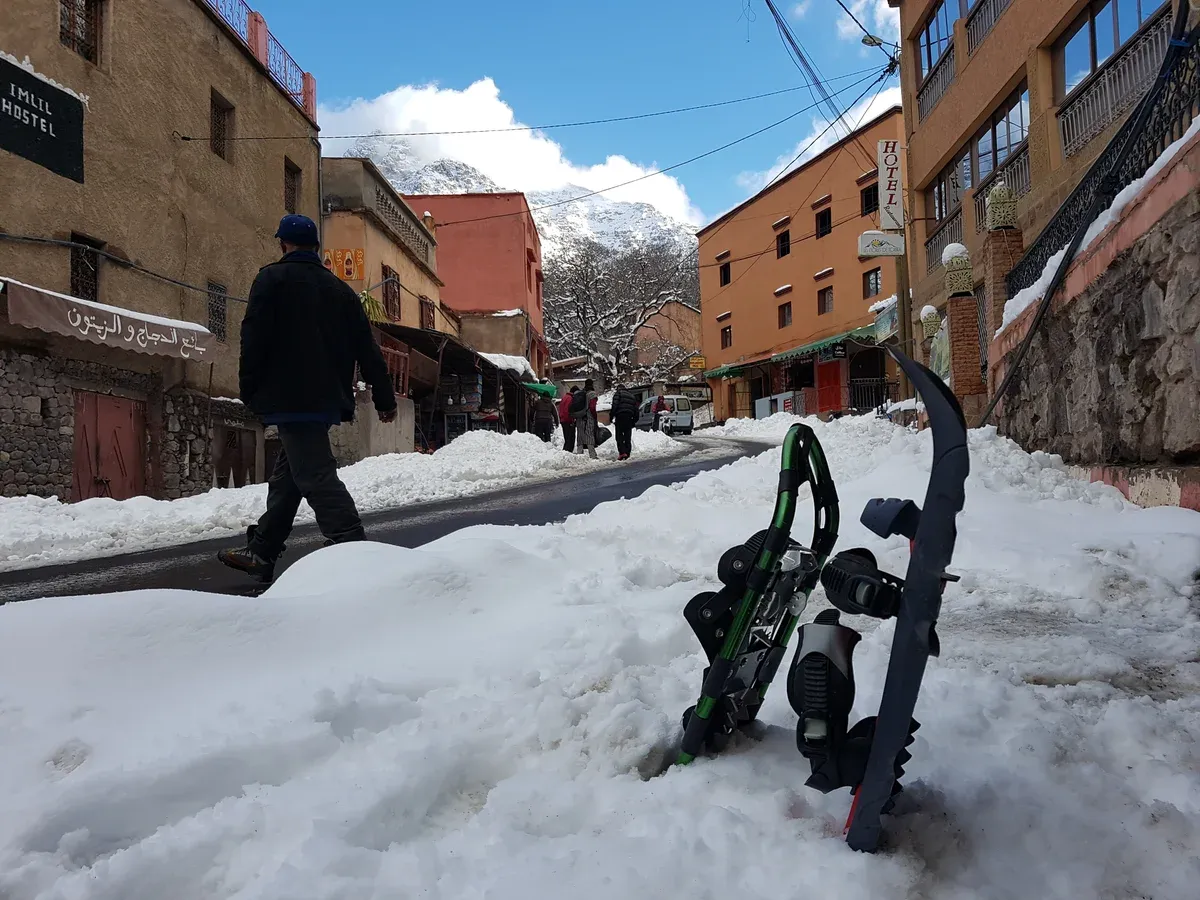
Snow on the street of a High Atlas village in winter. Photo: Musguide, CC BY-SA 4.0, via Wikimedia Commons
Quick answer When to go
The best time to visit Morocco is March to April and October to November, when Merzouga highs sit near 29 C in April and 30 C in October rather than 42 C in July. Summer pushes inland temperatures past 44 degrees, while winter brings freezing nights in the desert and snow on the Tizi n'Tichka pass from November through March. April and October score highest for Merzouga.
Key takeaways
- Short on time? The 3-day Merzouga Sahara desert tour runs the Marrakech to Erg Chebbi loop with a camp night, best done between October and May.
- Traveling in winter? Expect snow on the Atlas passes and sub-zero desert nights, so pack for it on any Morocco tour package that crosses the mountains.
- For the coast, Climates to Travel names May to October as best for Essaouira, which barely changes temperature all year.
- Compare the seasons against real itineraries in the full Morocco tour packages comparison before you book.
Morocco Month by Month
Morocco has three climates in one country. The coast stays mild all year, the inland cities swing from cold nights to extreme heat, and the Sahara and the High Atlas follow their own rules.
Temperatures and Rainfall Across the Year
The table below pulls the published monthly figures for four points that matter on a classic loop: Marrakech for the imperial cities, Errachidia for the desert approach road, Merzouga for Erg Chebbi, and Essaouira for the Atlantic coast. Errachidia sits about 130 km north of Merzouga. Where no monthly figure is published, the cell says so. Rainfall figures are annual totals per station unless a month is named.
Use the table as a pattern, not a promise. Marrakech has recorded 49.6 degrees in July and -3.6 in January, and Errachidia hit 43.9 on one July day. Extremes sit well outside the averages, but they show the range you should plan for.
| Month | Marrakech | Desert (Errachidia / Merzouga) | Coast (Essaouira) | Notes |
|---|---|---|---|---|
| January | High 19.1 C, low 5.9 C | Errachidia high 15.9 C, low 2.0 C, Merzouga high 18 C | High 18.4 C, low 11.1 C | Snow on Tizi n'Tichka, Merzouga nights drop below freezing |
| February | Not stated | Not stated | Not stated | Wikivoyage names February for trekking, Ramadan 2027 is listed from 8 February |
| March | Rainfall peaks at 35.2 mm, the year's wettest | Not stated | Not stated | Chergui wind peaks, snow still falls on the pass |
| April | Not stated | Merzouga high 29 C, scored 9.3/10 as best month | Not stated | Wikivoyage names April for the imperial towns, Rose Festival in May |
| May | Not stated | Named best for the Sahara | Climates to Travel names May to October as the best period | Festival season begins mid-May |
| June | 359.7 hours of sunshine, the year's most | Errachidia heating up, high 39.5 C in July nearby | Not stated | Fes Sacred Music and Gnaoua festivals, Mawazine in Rabat |
| July | High 37.7 C, record 49.6 C | Merzouga high 42 C, Errachidia high 39.5 C | Dry, highs run 18.4 to 22.6 C across the year | Saharan maximums exceed 44 C, peak tourist season |
| August | Low 21.1 C | Merzouga scored 2.5/10, the worst month | Sea peaks at 21 to 23.5 C on the Atlantic | Avoid the deep desert |
| September | Not stated | Not stated | High 22.6 C, the year's warmest | Imilchil marriage festival, Tanjazz in Tangier |
| October | Not stated | Merzouga high 30 C, scored 9.0/10, Errachidia wettest month at 20.8 mm | Not stated | Erg Chebbi best months run October to April, Erfoud date fair |
| November | Not stated | Not stated | Not stated | Chergui peaks again, snow returns to the pass, Independence Day on 18 November |
| December | Not stated | Not stated | Wettest month at 55.7 mm | Fes records its second-wettest month at 62.0 mm, nights are cold inland |
So Which Months Are Best?
The two best windows are March to April and October to November, which is exactly what the climate data supports: spring and autumn are named best for the imperial cities, April and October score highest for Merzouga, and snow still falls on the Tizi n'Tichka pass from November through March, so check conditions at the ends of those windows. A 10-day Morocco desert tour via the imperial cities covers Casablanca, Fes, the Sahara and Marrakech, so it touches all three climate zones.
Sources: Wikipedia: Morocco, Wikivoyage: Morocco
Cities, Desert, Coast and Mountains
The best month depends on where you are going. Each region of Morocco has a different answer, and a tour package usually crosses several of them in a week.
The Imperial Cities: Marrakech, Fes and Meknes
Marrakech draws more than two million tourists a year by one count and nearly 3 million by another. The city's mean daily highs run from 19.1 degrees in January to 37.7 in July, and it records around 3,252 hours of sunshine a year. Rainfall is modest at about 221 mm annually by Wikipedia's climate table (Climates to Travel gives about 285 mm), peaking at 35.2 mm in March and bottoming out at 2.2 mm in July. Climates to Travel names March to April and October to mid-November as the best window, and that is also when walking the medina's 19 km of walls and 18 souks is pleasant rather than punishing.
Fes runs slightly cooler and much wetter. Its mean highs go from 16.0 degrees in January to 35.1 in July and August, with the wettest months in November at 66.1 mm and December at 62.0 mm. Winter sightseeing works but buildings are often unheated, and a recorded January low of -8.2 degrees shows what cold snaps can do. For the cities alone, a 4-day imperial cities and Chefchaouen tour from Marrakech avoids the desert leg entirely, though Climates to Travel advises avoiding December to February inland.
- Marrakech: best March to April and October to mid-November, highs 19 to 38 degrees across the year
- Fes: best in spring and autumn, wettest in November and December
- Chefchaouen: the Rif can record over 1,200 mm of rain a year, far more than inland Morocco
The Sahara: Merzouga and Erg Chebbi
Wikipedia says the best months for Erg Chebbi are October to April, and a travel guide narrows that to April to May and September to November. The numbers agree. Merzouga's average highs run from 18 degrees in January to 42 in July, and BestDateWeather scores April at 9.3 out of 10 and October at 9.0, against 2.5 for August. Inland Saharan summer maximums in Morocco exceed 44 degrees, which makes midday dune walks and long drives punishing in summer.
Winter has the opposite problem. Camps sit at the edge of the dunes, 5 to 7 km from town, and winter nights in the Merzouga dunes drop below freezing. A writer who spent a night there noted the temperature falls quickly after sunset. The dunes themselves rise about 150 m above the plain and the field stretches about 28 km north to south. A camel ride to camp takes roughly 45 minutes to an hour and leaves one to two hours before sunset. Camps range from basic tents to a luxury desert camp in Merzouga with private bathrooms, and the class you pick matters more in winter than in May. For a short desert-only trip in the good season, the 4-day luxury Sahara tour from Marrakech crosses Tizi n'Tichka and sleeps at Merzouga, priced from $182 per person.
- Best: October to April, peak scores in April and October
- Avoid: June to August, Merzouga highs near 42 degrees in July
- Winter: below-freezing nights, so check what your camp provides
The Atlantic Coast: Essaouira
Essaouira is the easiest call in the country. Its mean highs only move from 18.4 degrees in January to 22.6 in September, so there is no bad month for temperature. The wind is the real variable: it blows all year, with stronger afternoon breezes in summer. Climates to Travel names May to October as the best period. Rain falls mainly in winter, with December the wettest month at 55.7 mm and July dry.
The sea is the catch. Essaouira's water sits around 17 degrees in winter and 21.5 in summer, and the same guide calls it very cool even in August, when Atlantic coast sea temperatures peak at 21 to 23.5 degrees. Swimmers head for the beach months of July to September and accept the chill. The medina became a UNESCO World Heritage Site in 2001, and if you time a visit for late June the four-day Gnaoua festival draws an estimated 450,000 to 500,000 visitors, which is either the point or the problem depending on your taste for crowds.
The High Atlas: Snow on the Passes
The Atlas runs about 2,500 km across three countries and holds Toubkal, the highest peak north of the Sahara at 4,167 m. Winter is serious up there. High Atlas temperatures can fall to -18 degrees and heavy snow lasts until May. The Tizi n'Tichka pass, a main road for Marrakech to Sahara tours, sits at 2,205 m by a 2022 GPS measurement, though the sign at the top still reads 2,260 m. Snow falls on it frequently from November through March, and it has closed entirely: heavy snowfall halted traffic in both directions on the Marrakech to Ouarzazate road at the pass at the start of 2026.
The practical advice for a winter package is to build in slack. The N9 over the pass is well paved but narrow in places, with frequent hairpins and few safe pull-offs, and a self-drive guide calls for a 4x4 and winter gear in the cold months. Summer and the shoulder seasons keep the pass reliable. Skiing exists too, at Oukaimeden, which runs six lifts between 2,600 and 3,200 m and logs about 47.5 snowy days a year. If your itinerary climbs to Ifrane in the Middle Atlas instead, expect roughly 960 to 1,100 mm of rain a year depending on the source, winter highs near 5 degrees and snow at altitude, a very different picture from Marrakech.
Best Time to Visit Morocco
Which months suit the cities, the coast and the desert. Third-party video by Morocco Closer. This site did not shoot it and has no relationship with the creator.
Ramadan, Eid and the Festivals
Two calendars shape when to go: the Islamic lunar calendar, which shifts each year, and a fixed festival season that runs from mid-May through the summer.
Ramadan and the Two Eids
Ramadan is the month to plan around if you are timing a trip. Ramadan 2027 is listed as running from 8 February to 8 March, with provisional Eid al-Fitr dates of Wednesday 10 and Thursday 11 March and provisional Eid al-Adha dates of Monday 17 and Tuesday 18 May, though some calendars put the start around Sunday 16 May.
Every one of these lunar dates depends on the official moon sighting, so treat them as provisional. The FCDO says only that Ramadan 2027 starts in February. During the fast the FCDO warns that public eating, drinking and smoking by day may offend, so carry snacks and eat discreetly. If you still want the Hassan II Mosque tour in Casablanca, Barcelo's guide gives Ramadan tour times of 9, 10, 11 and 14 Saturday to Thursday and 9, 10 and 14 on Friday, so confirm with the mosque before you go.
Morocco also has 11 fixed public holidays and 4 movable Islamic ones, including Throne Day on 30 July and Independence Day on 18 November. Fixed dates do not shift with the moon, so they are easier to plan around.
The Festival Calendar
The music and cultural festival season starts in mid-May and runs through the summer, so it overlaps with the hottest months inland. The largest, the Gnaoua Festival in Essaouira, draws an estimated 450,000 to 500,000 visitors over four days. Smaller events sit closer to the desert routes: the Rose Festival in Kalaat M'Gouna takes place every May over 7 days and reached 300,000 visitors in 2015, and the Erfoud date fair drew more than 94,000 visitors and is listed for 23 to 25 October.
The Imilchil marriage festival in September, at 2,119 m in the High Atlas, sees up to 40 couples marry on the same day.
| Festival | Where | Month |
|---|---|---|
| Fes Festival of World Sacred Music | Fes | June |
| Mawazine | Rabat | June |
| Gnaoua and World Music Festival | Essaouira | June |
| National Festival of Popular Arts | Marrakech | July |
| Jazzablanca | Casablanca | July |
| Rose Festival | Kalaat M'Gouna | May |
| Imilchil marriage festival | Imilchil | September |
| Tanjazz | Tangier | September |
| Moga Festival | Essaouira | September to October |
| Erfoud date fair SIDATTES | Erfoud | October |
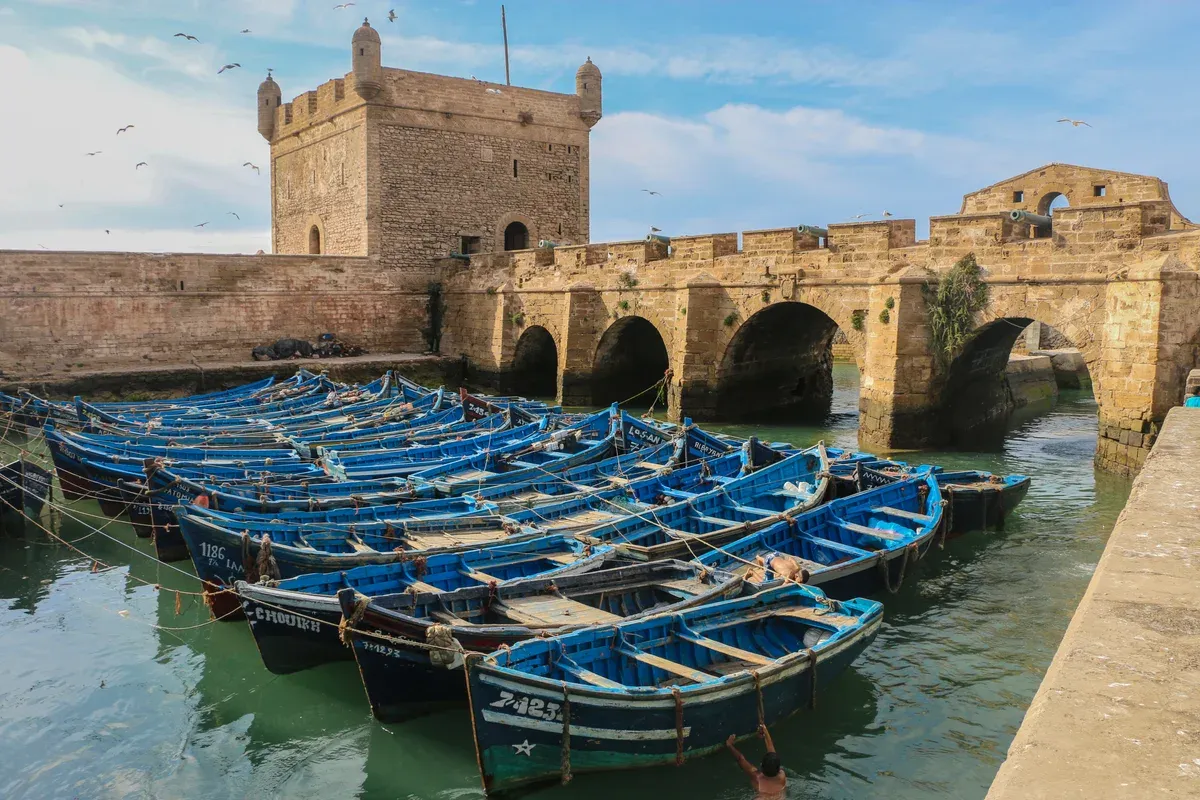
Blue fishing boats below the sea bastion of Essaouira. Photo: Ahmed.magdy, CC BY-SA 4.0, via Wikimedia Commons
Timing a Tour Package
The season changes what a loop tour feels like more than what it costs. Here is what each part of the year means on the road.
Spring and Autumn: the Easy Months
March to April and October to November suit the imperial cities and the desert alike. Merzouga highs are 29 C in April and 30 C in October, against 42 C in July, and Climates to Travel recommends October to April for Ouarzazate and Errachidia. The chergui, the local name for the sirocco wind, peaks in March and November and can reach 100 km/h, so a hot dusty day is possible in the shoulder seasons.
A private 7-day Casablanca to Marrakech tour from $1,511 per person on its 2 to 3 traveler option and the longer 10-day desert tour via the imperial cities at $2,403 per person, plus $302 in extra charges the booking platform adds at checkout, are two ways to cover the shoulder seasons.
Summer: Long Hot Drives
From June to August the desert leg becomes the hard part. Inland Saharan maximums exceed 44 C, Errachidia recorded a high of 43.9 C in 2021, and Marrakech mean highs reach 37.7 C in July. A drive from Marrakech to Merzouga takes 8 to 13 hours depending on the source, and a summer afternoon on that road is punishing.
On the classic 3-day Marrakech to Merzouga route, the 3-day Merzouga Sahara desert tour from $129 per person (the lowest of three options) has a day 3 return to Marrakech around 8 PM that the listing does not guarantee. The coast is the counterweight: Essaouira mean highs only range from 18.4 C to 22.6 C, which is why July is the coast's month. If you want the desert in summer, plan nothing strenuous at midday.
Winter: Cold Nights and Snow on the Passes
Winter is workable but cold. Merzouga highs are 18 C in January and winter nights in the dunes drop below freezing. High Atlas temperatures can fall to -18 C, and buildings inland are often unheated, which is why Climates to Travel advises avoiding December to February inland.
The bigger risk is the road. Snow falls frequently on the Tizi n'Tichka pass, the highest major pass in North Africa at 2,205 m by GPS measurement (the sign at the top says 2,260 m), from November through March, and heavy snowfall fully halted traffic there in both directions on 3 January. The pass may close seasonally.
A snow day can reshuffle an itinerary, so build in slack and check conditions the week you travel.
Do's and Don'ts for Picking Your Dates
Do
- Do aim for March to April or October to November if you want one trip that covers the imperial cities, the Atlas and the desert, because those are the months Climates to Travel names best for Marrakech and the imperial cities.
- Do book the desert leg between October and May, because that is the season The Travel and Wikipedia give for Erg Chebbi, with January highs of 18 C and April highs of 29 C.
- Do pack for freezing nights on winter desert stays, because winter nights in the Merzouga dunes drop below freezing and the temperature drops quickly after sunset.
- Do plan around Ramadan if daytime restaurant hours matter to you, because Ramadan 2027 is listed from 8 February to 8 March and public eating by day may offend per the FCDO.
- Do catch the coast in July and August if your dates are fixed to summer, because Essaouira mean highs stay at 18.4 to 22.6 C year round and the sea peaks at 21 to 23.5 C in August.
Don't
- Don't schedule the Marrakech to Merzouga drive in June to August if you can avoid it, because inland Saharan maximums exceed 44 C and the drive takes 8 to 13 hours depending on the source.
- Don't cross the Tizi n'Tichka pass in deep winter without checking conditions, because snow falls frequently there from November through March and the pass may close seasonally.
- Don't assume lunar dates are fixed, because all Islamic holiday dates in Morocco depend on the official moon sighting and Eid dates shift by a day or two.
- Don't visit the Rif town in the wettest weeks without rain gear, because Chefchaouen's annual precipitation runs from roughly 500 to 1,900 mm, far more than inland Morocco.
Frequently Asked Questions
Is Morocco warm all year around?
Mostly, but not everywhere. Marrakech mean highs run from 19.1 C in January to 37.7 C in July and the coast of Essaouira stays between 18.4 C and 22.6 C all year. The High Atlas can fall to -18 C in winter and Merzouga dune nights drop below freezing. See the month-by-month detail in the seasonal guide to the best time to visit Morocco on the Morocco trip packages.
What is the cheapest month to go to Morocco?
No month-by-month price data is published for these packages. What differs is the package: a 3-day Merzouga desert loop starts at $129 per person while a 10-day luxury private tour is $3,994 per person. Compare the dollar prices in the Morocco tour package comparison.
Is 7 days enough for Morocco?
Seven days covers a Casablanca to Marrakech loop with a desert night. A 7-day private tour from Casablanca to Marrakech from $1,511 per person on its 2 to 3 traveler option fits Rabat, Chefchaouen, Volubilis, Fes, the Sahara and Ait Ben Haddou, with the long drives spread across the week. Ten to eleven days add more slack for winter pass delays.
Is Ramadan a bad time to visit Morocco?
It depends on what you want. Ramadan 2027 is listed from 8 February to 8 March and depends on the moon sighting. The FCDO warns that public eating, drinking and smoking by day may offend, and Hassan II Mosque tours run reduced hours per Barcelo's guide. More context is in the Morocco travel guide.
When is the best time for a Sahara desert camp night?
October to April or May. Wikipedia names October to April as the best months for Erg Chebbi and The Travel runs the season to May. Merzouga highs sit at 29 C in April and 30 C in October against 42 C in July, and winter nights drop below freezing so bring warm layers. Camp and camel details are covered in the guide to a luxury desert camp in Merzouga.
Does the chergui wind affect travel plans?
It can. The chergui is Morocco's version of the sirocco, it can reach 100 km/h and it peaks in March and November, which sit inside the otherwise best travel months. The desert routes and timings are laid out in the classic Morocco loop route guide.